Sunday, September 26, 2021
Spectrum Teaching Strategy
Wednesday, June 9, 2021
Social Studies Super Bundles
Are you constantly spending time searching for updated social studies materials? Or, are you always trying to find ways for students to have FUN while learning social studies content? Is there an anxious feeling while trying to differentiate for each student? Don’t worry, you are not alone! It can be so hard to find engaging content that will work for all students. Thankfully, there are Social Studies Super Bundles ready for purchase. However, these bundles are so amazing that they won’t be available forever. The Social Studies Super Bundles are only available from June 13th-June 20th. The bundles are so amazing that you are going to want to set your calendar reminder now!
Benefits of Available Bundles
Sometimes, people are hesitant to purchase bundles due to the higher upfront cost. There is often concern over the quality of all of the resources and if this justifies the cost. Thankfully, the Social Studies Super Bundles are filled with 100+ high-quality printable and digital resources. All of the activities are fun, engaging, worthwhile lessons! Even better, the bundles are only $20 during this exclusive sale!
After purchasing, huge stress will be lifted due to spending less time planning. HOURS of your time will be saved with these ready-to-go resources! Even better, all of the resources bring in updated and innovative teaching strategies. For example, students will be playing digital games, moving to stations, using Boom Cards, and completing web searches. Therefore, you will be able to read the book on your list, catch up on TV, play with your kids, or take a much-needed nap. After purchasing these bundles, say goodbye to stressing over lesson planning!
Video URL(embed it)- https://youtu.be/G6J5u1u0wYc
The incredible resources here will cover a variety of topics. Therefore, one $20 bundle will be spread across the entire year! Hence, teachers will never have to worry about not having an engaging lesson ready to go. More importantly, each lesson includes a component on anti-racism education, which is so important in the world today! Therefore, students are learning about history while working to create a better future. Some of the topics include The Cuban Missile Crisis, Hamilton’s Financial Plan, and The American Revolution. Each lesson includes innovative teaching strategies in order to encourage and inspire all students. Over 48 products included in this package!
Ancient Civilization and World History Bundle
Sometimes, students have trouble understanding why the past is so important to learn about. Therefore, this $20 bundle will bring in creative ways to show students how current societies learn from ancient civilizations. To do this, students will learn about many topics, such as the Fall of Rome and different religions. As above, there is also an anti-racism focus in order to help foster supportive communities. The 34 activities all bring in creative teaching strategies to offer full engagement.
Due to the different branches and legal components, Government can be a really hard topic to understand. There is just so much to learn! Hence, this $20 bundle has 40+ activities that will break down complex topics in addition to an anti-racism focus. For instance, students will learn about presidents, the Constitution, and Supreme Court cases. Just like the above, all of the activities are high-quality and filled with current teaching methods. Over 31 products included in this package.
When buying these bundles for only $20 each, tremendous stress will be lifted from your plate! Since multiple sellers came together to create these incredible bundles, they won’t be around for long. You can save hundreds of dollars and hours of time, but this is only offered from June 13th through June 20th at 11:59 PM. This is a one-time opportunity, so be sure not to miss out!
Thursday, April 15, 2021
Exit-Slips/Ticket-Out-The-Door TEACHING STRATEGY
At the end of each lesson, do you often ask yourself if your students understood the lesson? What ways and how often do you check for understanding? One of the most popular strategies for many teachers is Exit Slips or Tickets-Out-The-Door. This strategy is used to help students process the information and reflect on what they learned. They also incorporate writing and make quick formative assessments.
Exit slip questions may fall into these specific categories:
1. Prompts that demonstrate knowledge of a topic.
*Ex. Write three things you learned from today's lesson.
*Ex. Explain one idea that you found the most interesting.
2. Prompts that make students critically think about the lesson.
*Ex. One idea I need clarified is...
*Ex. One question I have about the topic is...
Other questions you may ask:
*What made learning easy for you today?
*What made learning difficult for you today?
*What do you still need to know before we move on?
*What did you learn today?
*What should our next step be?
How to use this strategy:
1. At the end of the lesson or a few minutes before class ends, ask students to respond to a prompt you created beforehand.
2. Distribute small pieces of scratch paper or sticky notes, or have students complete a digital version if your classroom is paperless. Be sure they include their name.
3. To exit the class or to be excused, students must turn in their Exit Slip. I usually stand by the door and quickly review each slip. I then place the papers in two piles; "they got it" or "they need more clarification." If I see that many students did not understand the topic or have more questions, I spend a few minutes the next day to reteach. If students use a digital version, I give students a point from 1-5. One means they did not understand the lesson, Five means they understood the major concepts, and reteaching is unnecessary.
If you are looking for some fun formative assessments, click HERE.
I hope you found this post useful. Click HERE to grab over 70 teaching strategies for FREE!
Happy Teaching,
Monday, January 11, 2021
Teaching in Difficult Times
When a crisis happens and makes its way to our classroom, it's often difficult to know how to support our students. Below are some resources that can guide you in your classroom when news unfolds.
1. Allow your students to share their feelings. As a Psychology teacher, I know one of the worst things people can do when they have intense emotions is to hold those feelings in. After a challenging event, give students time to simply share their feelings. You could start out with a writing prompt. For example, you may ask;
What did you hear about what happened?
What feelings do you have?
What questions do you have?
Then have students volunteer to share in small groups or hold a whole-class discussion. If you don't want to use class time to discuss the tragedy, you may want to invite them to email you personally or email their counselors. Students must be able to share their feelings with someone in some way.
2. Reassure your students. Most likely, your students are scared and worried. Reassure your students that things will get better. And if they still have concerns, they are welcome to contact you, another teacher, administrator, or counselor. Remind them that they are safe. Here is a download from the American Red Cross that will help children of all ages deal with trauma.
3. Turn feelings into action. Often times after a crisis, students feel helpless. They may want to help, but they are unsure of the ways they can. Brainstorm with your class on ways they can support others during difficult times. Often focusing on others may help your students distract themselves from their own fear and worry. For example, after 911, my 12-year-old daughter and her friends decided to sell American flag pins and give the earnings to help support those families who lost loved ones in the tragedy.
4. Help students become wise consumers of information. During difficult times, more than ever, our students should evaluate facts from fiction in the media. I always tell my students, "if you only learn one thing from my class, it is the ability to think critically". This Civics Education Resource Site has a variety of useful information to teach media literacy in your classroom.
5. Consider how what is happening can relate to your course. Evaluate if the event can connect to the learning outcomes in your course of study. This can be a powerful way to integrate real-world events into your classroom. For example, you may consider comparing and contrasting the Covid-19 Pandemic of 2020 to the Spanish-Flu Pandemic of 1918.
I would love to hear your ideas when teaching during a crisis. We can all learn from each other.
Take care and be safe,
Sunday, April 26, 2020
DISTANCE LEARNING Teaching Strategies
In this post, I wanted to share some of the distance learning strategies I currently use that might make your teacher-life a little easier.
1. Think of yourself more like a coach than a teacher. I'm sure we can all agree, online learning is much different than classroom learning. You are essentially having your student fly a plane while you are in the tower. It's up to you to help them land the plane.
2. Don't feel obligated to use Zoom or some other video conferencing app. with your students. In fact, it's much better to use video conferencing to help answer questions or clarify directions than it is to teach.
3. Consider screencast and record yourself giving direct instruction. You don't need to be live. I have also found many great videos on YouTube to replace my direct instruction. Students will also have the option to pause and rewind if necessary.
4. Have your students participate in online, class discussions. Here are a few ideas:
- In Google Classroom you can assign a "question" and select the option, "students can reply to each other"
- Create a Google "sheet". Be sure to change the share settings to "anyone can edit". Type a section for students to write their names and answer a question. This allows students to see responses from all the students in the class.
- Use Zoom "Break-Out" rooms
- Have students share the same Google Doc.
- Insert sentence frames directly into only those students who need a little extra help.
- Use Newsela.com to differentiate reading passages.
- To give a differentiated assignment to only a few students follow these directions:
- When creating an assignment in Google Classroom instead of selecting all students, select only those students you wish to give the assignment to.
7. Use Google Calander to make appointments with individual students to help clarify instruction and answer specific questions.
8. Use GoFormative.com to insert questions into text. This will help assess student learning as they read instead of after they finish reading the entire passage.
9. Use a lot of white space in online reading passages. Students learn 25% slower than using a paper copy. Short paragraphs with a lot of white space will make it much easier for students to learn.
10. Be patient. Although most students are very familiar with technology, they may need a little extra time and patience to get used to learning from a distance!
The majority of my TpT resources are now digital. Go grab some freebies HERE to make distance learning even easier.
Happy Teaching!
Friday, January 17, 2020
Carousel Brainstorming Teaching Strategy
Tuesday, October 15, 2019
LINES OF COMMUNICATION Teaching Strategy
1. Have students get into two lines. Each student faces another student. You may want to consider having the students go outside since you will need a lot of space.
2. Next, have students discuss important ideas, debate a topic, or review the main ideas from a lesson.
3. Once both partners have shared, have one line move in the same direction to the next student and repeat the process. Below are some ideas I use in my classroom.
I have my Civics students debate the death penalty after they read this informational text.

In my World History class, I have my students learn about the Enlightenment Philosophers and discuss the question: Which Philosopher was the most significant in the development of democracy and why?


Happy Teaching,
Chalk Dust Diva
Wednesday, May 22, 2019
PHILOSOPHICAL CHAIRS Teaching Strategy
Below are the steps to implement Philosophical Chairs in the classroom:
STEP 1: Create signs to hang in the classroom: Totally Agree, Agree, Disagree, Totally Disagree. Hang one sign in each corner of the classroom.
STEP 2: First students need to learn about a specific topic. The teacher may wish to use direct instruction, show a film clip, or assign a reading, newspaper article, short story, etc.
STEP 3: The teacher will then present a statement or high-level question that may provoke thought and discussion. Some examples I use in my social studies classroom may include:
* U.S. History: President Truman was justified in dropping the atomic bomb on Japan.
* World History: After reading excerpts from Leviathan by Hobbes. "People cannot be trusted to govern"
* Civics: After reading "Civil Disobedience" by Henry David Thoreau, "The government is best which governs least".
STEP 4: Give students a few minutes to think about their opinion related to the question. You may have students write their opinion on a piece of paper.
STEP 5: Tell students to move to the corner of the room that has the sign that matches their opinion: Totally Agree, Agree, Disagree, Totally Disagree. Tell students to they may be called upon to share their opinion with the class. You might want to have students discuss their opinions with the people they are standing next to so they can practice their response. Tell students they can also change their opinion at any time and move to a different corner of the room. * To simplify this strategy simply remove the Totally Agree and Totally Disagree signs and have them move to either one side of the room or the other.
STEP 6: Ask volunteers to share their opinions. If no student volunteers, then call on students randomly to share their answers. You can use a simple rubric to assess their responses or give extra credit points.
STEP 7: At the end of this activity you may want to give your students a formative assessment. Some questions you may want to include:
1. What is your final opinion? Explain your reasoning in detail.
2. What were at least two opinions that are opposite of yours? What made you disagree with these opinions?
3. Are there still questions you may have about this topic?
STEP 8: Before beginning this activity you may want to review the following rules of engagement and post them on the board.
1. No talking while someone else is speaking.
2. Have an open mind and try to understand the person's point of view.
3. Explain your opinion and reasoning using academic language.
4. Respond to opinions only, not the personality of the person.
I would love to hear how you conduct this strategy in your classroom. Comment below!
Happy Teaching!
Tuesday, April 16, 2019
JIGSAW Reading Strategy
The benefits of this strategy include:
1. It will help students with various reading abilities gain comprehension.
2. It will save a lot of time when there is a lot of content to teach.
3. Students will be able to practice listening and speaking skills, especially helpful for students who are designated English Language Learners (ELL).
4. Discussion of reading passages will help students remember important ideas.
Steps to implement the strategy in your classroom:
1. Choose a long reading passage and divide it into even sections. (I have four students per group, so I divided the readings into four sections.)
2. Divide your class into "home" groups. The amount of students per group depends on the class size and the number of sections per reading.
3. Assign each student a specific section of the reading.
4. Students who have the same assigned reading will form "expert groups" and read aloud their assigned text. You may require students to annotate the reading and complete a corresponding graphic organizer or answer key questions. Be sure all students are discussing the reading with their "expert" groups so to confirm comprehension.
5. Once "expert" groups have completed their assigned reading, have students return back to their "home" groups.
6. Have students share the main ideas from their reading to their "home" group members. Group members will take notes on their graphic organizer.
Below are examples of the Jigsaw strategy I use in my classroom.
MAIN Causes of World War I
Note: Although this is a group project, this could easily be revised into a Jigsaw activity.
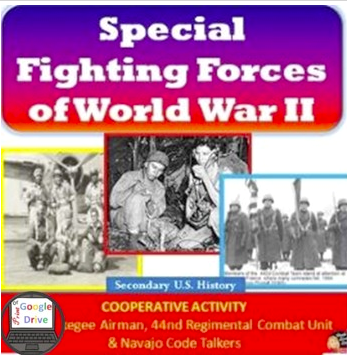
Special Fight Forces of World War II
Have you used this strategy in your classroom before? If not, what are you waiting for?
Happy Teaching,
Chalk Dust Diva
Wednesday, April 3, 2019
THUMBS UP, DOWN, SIDEWAYS Teaching Strategy
Monday, March 18, 2019
WHIP AROUND Teaching Strategy
STEP 1: Have each student write down two or three possible responses to a prompt or question.
STEP 2: Then have students, in order, share out one of their responses using a public speaking voice.
STEP 3: Ask all students to stand up prior to speaking, then as they share they sit down. You may want to have student pair-share prior to having them share with the entire class.
This activity is best meant to be a quick moving activity that only takes a few minutes. If your class is large use only one or two rows, not the entire class.
This strategy works best when summarizing or to be able to hear from multiple voices in the room. It is also a good end-of-period activity.
Make sure the question being asked has many answers and they or not long and/or complex.
How do you assess your students? I would love to hear about your ideas! Leave a comment below.
Are you looking for more teaching strategies? Click HERE to get 70 strategies for FREE!
Happy Teaching!
Monday, February 18, 2019
WAGON WHEEL Teaching Strategy
This strategy provides students an opportunity to engage in a formal discussion and experience roles both as participant and as an active listener. Students also have the responsibility of supporting their opinions and response using specific textual evidence.
How it works...
Students are asked to engage in a group discussion about a specific topic - there will be two circles;
Inner circle students will model appropriate discussion techniques... while the outer circle students will listen, respond and evaluate. Have the outer students rotate every few minutes.
For larger classes, you might want to break up the class into two separate wagon wheels.
Thursday, January 17, 2019
FOUR CORNERS Teaching Strategy
Below are the steps to teach the "Four Corners DISCUSSION" teaching strategy:
STEP 1: The teacher posts questions, quotations, photos, etc. in each of the corners of the room.
STEP 2: The teacher assigns each student to a corner… or students choose.
STEP 3: Once in the corner, the students discuss the focus of the lesson in relation to the question, quote, etc…
• At this time, students may report out or move to another corner and repeat the process…
STEP 4: After students have moved… as a writing assignment, they should be encouraged to reflect on changes in opinion or new learning.
Below are the steps to teach the "Four Corners OPINION" teaching strategy:
STEP 1: Post opinions about a scenario in four corners of the classroom. Examples would include: Strongly Agree, Agree, Disagree, and Strongly Disagree
STEP 2: Present the controversial scenario to your students.
STEP 3: Students express their opinion about the scenario by standing in front of one of four corners with students of the same opinion.
STEP 4: Call on student volunteers or ask random students to share their opinion. Tell students that if they choose, they may change their opinion at any time and move to another corner.
If you decide to try this strategy, I would love to find out how it goes!
Get over 70 teaching strategies for FREE by clicking HERE!
Happy Teaching!
Monday, December 17, 2018
TALKING CHIPS Teaching Strategy
Directions for Talking Chips:
STEP 1: Place students in small groups. I use groups of four students.
STEP 2: Pose a question for students to discuss. I usually pose an opinion-type question about the current unit of study. For example, as a history teacher, I might ask,
"If you were President of the United States what would be your recommendations to combat the Great Depression?"
or
"What do you think is the most important right in the first amendment?"
STEP 3: Each member is given a "chip" ( a small piece of construction paper or a real "chip")
STEP 4: Each student takes turns "talking" by placing their "chip" into the center of the table.
STEP 5: The first person to talk may only talk at that time - and may not speak again until all group members have placed their "chip" in the middle.
Repeat process
Have you tried using this teaching strategy in your classroom? What questions did you ask your students?
I hope you found this teaching strategy helpful. To get a list of over 70 teaching strategies for FREE click HERE!
Happy Teaching!
Monday, November 19, 2018
FINAL WORD Teaching Strategy
STEP 1: Divide the class into groups of four.
STEP 2: Give each group a controversial statement or question.
STEP 3: Students prepare their arguments prior to the activity.
STEP 4: Students create a quad chart and label each square A, B, C, D and assign each student a letter.
STEP 5: Student A talks for one minute about their prepared arguments while students B, C, D take notes and creates questions.
STEP 6: Student B then has a minute to discuss, ask questions, and make comments about what student A said. Students C and D will do the same.
STEP 7: Student A then states their "final word" answering questions and restating their arguments.
STEP 8: Continue the process for students B, C, and D.
To get 70 engaging teaching strategies for FREE click HERE!
Happy Teaching!
Sunday, October 28, 2018
Three-Step Interview Teaching Strategy
STEP 1: Teacher presents an issue(s) to the class that will result in varying opinions or outcomes.
STEP 2: Students find a partner and movies their desks so they are facing each other.
STEP 3: Students work in pairs with on the interviewer, the other the interviewee.
STEP 4: At a given signal, the partners switch roles.
STEP 5: After one round of interviews have one person from each team find another partner and share their first partner's ideas.
* NOTE: This is most effective when there is not one right answer.
The benefits of this strategy:
1. Students practice listening and discussion skills. active listening skills
2. Promotes communication skills.
3. Students are able to express their opinions in front of one person at a time instead of the entire class.
4. Encourages students to practice accountability skills.
There are many other variations for this activity. What variations have you tried?
To get over 70 teaching strategies for FREE click HERE!
Saturday, September 15, 2018
Constitution Day Classroom Activities
1. Have your students participate in a Constitution Scavenger Hunt:
Students will work with a partner and compete against other teams to find answers to 20 scenarios. This is a great critical-thinking activity and lots of fun too!
2. Test your students' knowledge about the Constitution with this fun game! Get it FREE HERE.
3. Explain the structure of the Constitution with this engaging presentation. It reviews the Articles of Confederation, the three branches of government and includes a notes template and film clips.
4. If you teach Civics this presentation might be helpful because it reviews the Principles of the Constitution; Popular Sovereignty, Limited Government, Separation of Powers, Checks and Balances, and Judicial Review.
I hope you find these resources useful!
Happy Teaching!
Sunday, August 19, 2018
Back-To-School Checklist
1. I first set up all technology in my classroom. I confirm my LCD projector and laptop work properly. I make sure my students' technology cart is charging and ready to go the first day. I set up my Google Classroom adding my syllabus and "About" section. I also update the school website with the courses I'm currently teaching. At this time, I might also set up my categories into the grading system.
2. The next thing I do is to create my syllabus. I usually create this before I leave for the summer and make any copies I need according to my class count when I return before the first day of school. I get a sample textbook to show the students what book they will be picking up during textbook distribution. I also get my teacher edition textbook.
3. I then set up my room. I don't stress about getting everything completed before the first day of school. I have my teachers-aid complete what I didn't finish once school begins. However, I do make sure I have the agenda and objective on my board before my kiddo's enter the classroom.
4. I then make sure I have lesson plans completed for at least the first two weeks of school. I usually have an entire unit completed before I leave for the summer. This makes my first week of school much less stressful. I also make sure I make copies of all the worksheets I need for the first week of school. Now that I'm paperless, I make sure the first day's assignment has been posted on Google Classroom.
5. For my next task, I enter all the important dates into my school calendar. (Sometimes I have my Teachers-Aid complete this for me.) I also color-code all events to make it easier to view.
6. I then make my seating chart. Since I don't know my students yet, I just place them in a random order. This always changes the first week of school when students are added and dropped from my class. The second week of school I print the seating charts and place them in a binder. I color-code the seating chart with essential information. For example, if a student is an English-Language-Learner I might highlight their name in blue. Special-Ed students might be highlighted in yellow.
Once the above has been accomplished, I take a deep breath and anticipate the beginning of the new school year.
Anything you would add to this list? Share your comments below!
Check-out all my back-to-school teaching strategies HERE!
Happy Teaching!
Wednesday, June 20, 2018
Summer School Teaching Strategies
1. On the first day of school be sure to explain to students that it is a VERY fast-paced class. In my school district, we teach 4 hours a day for six weeks. Being absent even one day may jeopardize their grade in the class. Believe it or not, I've had many students fail summer school because of their absences.
2. Review your state standards and determine the focus standards you want to teach. Because of the pace of the class, you will not have time to incorporate all of the content standards. Don't feel guilty! For example, during the regular school year when I teach about World War I, I explain the causes, effects, significant leaders, strategies, and battles, etc. However, during summer school I might only teach about the causes and effects, and incorporate the other standards if I have time.
3. Consider trying out new teaching strategies you've always wanted to try. Summer school is a great time to try new things. Ask your students to give you feedback and make revisions before using the strategy during the regular school year. Consider assigning a project where students can choose a topic they want to learn about. Giving students a choice is a great way to differentiate!
4. Since most students who take summer school most likely failed a class, begin with a "Growth Mindset" activity. On the first day of summer school, I always use this engaging activity.
5. Since most of your students may need extra support in reading and writing, focus on teaching essential strategies to give them more academic support. For example, spend more time teaching your students how to write a DBQ rather than teaching about every battle during World War II.
6. Remember, you want to enjoy your summer vacation too! So make it a policy to NEVER take work home with you. Create your daily plan to incorporate time to grade assignments. For example, if you assign a paragraph assessment, have your students work on a project or a student-centered activity. This will give you time to grade the assignments.
If you are teaching World History summer school this year, check out this FREE lesson plan and BUNDLE of resources to make your life a little easier!
Happy Teaching!
Monday, April 16, 2018
Clock Partners Teaching Strategy
By setting up a conversation structure using clock times, this activity encourages a range of student interactions.
The teacher distributes a "clock face" handout to each student with spaces to write partner names at 12:00, 3:00, 6:00, and 9:00. Then have the students walk around the room and make "appointments" with other students that they will take with at a later time.
Looking for more creative teaching strategies? Click HERE!
Happy Teaching!