Facebook Instagram Pinterest Twitter History Chalk Talk Home About Me My Products Freebies BlogLovin' Image Map


Showing posts with label election lesson plans high school secondary. Show all posts

Sunday, September 26, 2021

Spectrum Teaching Strategy

Are you looking for a fun strategy to get your students out of their seats? This activity is especially great for kinesthetic learners.  It will also help both the teacher and the students to "see" the opinions of others. This is a strategy to be used when asking for student opinions on a topic or question. 

Below are the steps to implement the "Spectrum" activity in your classroom;

Step 1: Place a line across the whiteboard or a piece of masking tape on the floor, from wall to wall in front of the room.

STEP 2: Label one end "Strongly Agree" and the other end "Strongly Disagree".

STEP 3: Students line up according to an opinion on a topic.
* other label ideas could be "Most Important/Least Important". "Greatest Effect/Least Effect"

STEP 4: Call on specific students or volunteers to explain the reason they are standing where they are on the spectrum. 


Below are some of my teaching resources you can use this strategy with:


Happy Teaching!


Tuesday, April 16, 2019

JIGSAW Reading Strategy

Research proves that the best way to learn is to teach. The Jigsaw reading strategy is a cooperative activity in which students take on the role of  "experts" about an assigned reading passage or topic and teach the information to their group members.


The benefits of this strategy include:
1. It will help students with various reading abilities gain comprehension.
2. It will save a lot of time when there is a lot of content to teach.
3. Students will be able to practice listening and speaking skills, especially helpful for students who are designated English Language Learners (ELL).
4. Discussion of reading passages will help students remember important ideas.

Steps to implement the strategy in your classroom:
1. Choose a long reading passage and divide it into even sections. (I have four students per group, so I divided the readings into four sections.)
2. Divide your class into "home" groups. The amount of students per group depends on the class size and the number of sections per reading.
3. Assign each student a specific section of the reading.
4. Students who have the same assigned reading will form "expert groups" and read aloud their assigned text. You may require students to annotate the reading and complete a corresponding graphic organizer or answer key questions. Be sure all students are discussing the reading with their "expert" groups so to confirm comprehension.
5. Once "expert" groups have completed their assigned reading, have students return back to their "home" groups. 
6. Have students share the main ideas from their reading to their "home" group members. Group members will take notes on their graphic organizer.

Below are examples of the Jigsaw strategy I use in my classroom.


MAIN Causes of World War I

Landmark Supreme Court Cases

Note: Although this is a group project, this could easily be revised into a Jigsaw activity.

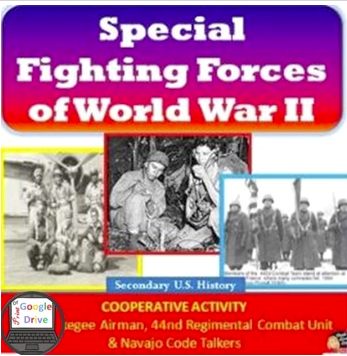
Special Fight Forces of World War II

Have you used this strategy in your classroom before? If not, what are you waiting for?

Happy Teaching,
Chalk Dust Diva

Monday, April 16, 2018

Clock Partners Teaching Strategy

Are you looking for a fun and creative way to set up partners in your classroom? This is one of my favorite strategies: Clock Partners.

By setting up a conversation structure using clock times, this activity encourages a range of student interactions.

The teacher distributes a "clock face" handout to each student with spaces to write partner names at 12:00, 3:00, 6:00, and 9:00. Then have the students walk around the room and make "appointments" with other students that they will take with at a later time.

https://www.teacherspayteachers.com/Product/Instructional-Strategies-for-ANY-Classroom-70-Total-helpnorcal-3015575

·          This strategy requires students to get up and move around the room to dialogue with students not directly near them.
·         Not all clock appointments need to be facilitated at once – maybe for one activity use 3:00, another 9:00.  Also, appointments can be standing for a period of time. 

Note: Avoid using this strategy when strategic student pairing is critical to the outcome of the activity.

Click HERE to get a FREE Clock Template 

Looking for more creative teaching strategies? Click HERE!

Happy Teaching!

Sunday, March 11, 2018

THINK-PAIR-SHARE Teaching Strategy


Research shows that the most effective teachers ask an average of 24 questions (at all levels) during a 50-minute period; the least effective asked an average of 8.6 questions.


Think-Pair-Share is a great strategy to incorporate questions into any lesson. Just follow the instructions below:

The teacher will ask a question to the entire class and give at least 3-5 seconds to have the students think about the answer. Then the students share their answers with a partner. The teacher will then randomly call on a few students to share their answers in front of the class. This can be done throughout a lesson to check for understanding. I usually make sure the my students answer in complete sentences using academic language. 

For every unit I post a "Word Wall" so my students have something to refer throughout the lesson. Get a FREE Word Wall HERE!

If you are looking for more engaging teaching strategies click on the HERE!
https://www.teacherspayteachers.com/Product/Instructional-Strategies-for-ANY-Classroom-70-Total-helpnorcal-3015575
Happy Teaching!

Sunday, December 3, 2017

IDEA WAVE Teaching Strategy


Are you looking for a fun activity to check for understanding? Here is a great teaching strategy the entire class can participate in. Read below for the directions for an IDEA WAVE. 


After students learn about a specific topic each student shares ideas they learned about that topic.
·         A volunteer begins the “idea wave” by sharing one idea.
·         The students to the right of the volunteer shares one idea; the next student to the right shares one idea.
·         The teacher directs the flow of the “idea wave” until several different ideas have been shared. 

At the end of the formal "idea wave, " a few volunteers who were not included can contribute an idea.

To put a twist on the idea wave, ask all students to stand and share information they learned about the topic. Tell the students that they must speak in complete sentences using academic langauge. (I post word walls for every unit for students to refer to). I say to the class, "the person who goes first is the person who is speaking". They cannot repeat information that someone else has already said, so they need to listen carefully. The goal for the students is not to be the last person standing. 

This is a great way to assess your student's knowledge about any topic and then be able to reteach information if necessary. 

To see more teaching strategies click HERE!

Happy Teaching!

Chalk Dust Diva

Sunday, August 6, 2017

Reciprocal Cooperative Reading Strategy

One of my favorite reading strategies I use in my secondary history class is Reciprocal Teaching. So what is Reciprocal Teaching you may ask? It is a multi-strategy approach to assist students in understanding the meaning of text. Students are asked to:
  • make predictions about what is going on in the text
  • generate questions about the text content
  • seek clarification of points that are not well understood or confusing
  • summerize what has been read
 The goal of RT is to have the student automatically use these strategies when reading.

Here is a great resource to teach reciprocal teaching in the classroom. Comes with everything you need to easily implement this strategy in your classroom!

https://www.teacherspayteachers.com/Product/Reciprocal-Teaching-Strategy-Presentation-Student-Handouts-2700583

ab

Sunday, April 23, 2017

Teach with Movies - The Cold War

Are you looking for a way to keep your history students engaged  -  even when they are not in school? A great way to do this is to have your students watch films related to the current unit of study.  For each unit, I give my students a list of films my students could watch for extra credit. After they view the film they are required to complete a set of questions that will help them connect the movie to the current course of study. Get this FREE worksheet by clicking HERE! 

Below are a list of films I suggest when teaching the Cold War. 


Bridge of Spies
The Killing Fields
Inherit the Wind
Fail Safe
Argo
For Love of Country
A Gentleman's Agreement
Dr. Strangelove
Desert Bloom
The Crucible: 1957 version
Apollo 13 
Hiroshima Maiden
Force More Powerful
Seven Years in Tibet
War and Peace
Truman
Seven Days in May
Sayonara
The Russian's are Coming!
The Right Stuff
October Sky 
October Sky 
Quiz Show 
The Right Stuff 
Born on the Fourth of July 
Letters Home from Vietnam

Are there any films I am missing from this list? Let me know by commenting below! 

Happy Teaching! 
Related Posts Plugin for WordPress, Blogger...