Facebook Instagram Pinterest Twitter History Chalk Talk Home About Me My Products Freebies BlogLovin' Image Map


Showing posts with label teaching strategies. Show all posts

Sunday, April 26, 2020

DISTANCE LEARNING Teaching Strategies

Distance learning is no joke! I feel like I'm spending so much more time teaching online than I did in the classroom. Anyone else feel the same?

In this post, I wanted to share some of the distance learning strategies I currently use that might make your teacher-life a little easier.

1. Think of yourself more like a coach than a teacher. I'm sure we can all agree, online learning is much different than classroom learning. You are essentially having your student fly a plane while you are in the tower. It's up to you to help them land the plane.

2. Don't feel obligated to use Zoom or some other video conferencing app. with your students. In fact, it's much better to use video conferencing to help answer questions or clarify directions than it is to teach.

3. Consider screencast and record yourself giving direct instruction. You don't need to be live. I have also found many great videos on YouTube to replace my direct instruction. Students will also have the option to pause and rewind if necessary.

4. Have your students participate in online, class discussions. Here are a few ideas:

  • In Google Classroom you can assign a "question" and select the option, "students can reply to each other"
  • Create a Google "sheet". Be sure to change the share settings to "anyone can edit". Type a section for students to write their names and answer a question. This allows students to see responses from all the students in the class. 
  • Use Zoom "Break-Out" rooms 
  • Have students share the same Google Doc. 
5. If you use Google Classroom, instead of spending the time to open each student's assignment individually open all students' assignments at once. Simply open the assignment folder in your drive and you'll see all the assignments at once. Save a ton of time!

6. For your struggling students, you can differentiate instruction in several ways. 
  • Insert sentence frames directly into only those students who need a little extra help. 
  • Use Newsela.com to differentiate reading passages.
  • To give a differentiated assignment to only a few students follow these directions: 
    •  When creating an assignment in Google Classroom instead of selecting all students, select only those students you wish to give the assignment to. 

7. Use Google Calander to make appointments with individual students to help clarify instruction and answer specific questions.

8. Use GoFormative.com to insert questions into text. This will help assess student learning as they read instead of after they finish reading the entire passage. 

9. Use a lot of white space in online reading passages. Students learn 25%  slower than using a paper copy. Short paragraphs with a lot of white space will make it much easier for students to learn.

10. Be patient. Although most students are very familiar with technology, they may need a little extra time and patience to get used to learning from a distance!

The majority of my TpT resources are now digital. Go grab some freebies HERE to make distance learning even easier.

Happy Teaching!


Wednesday, May 22, 2019

PHILOSOPHICAL CHAIRS Teaching Strategy

Philosophical Chairs is an engaging teaching strategy to get students to think about their beliefs on important topics and to be able to discuss and share their ideas. It allows students to critically think, verbally ponder, and logically write their beliefs on a variety of ethical issues and topics.


Below are the steps to implement Philosophical Chairs in the classroom:

STEP 1: Create signs to hang in the classroom: Totally Agree, Agree, Disagree, Totally Disagree. Hang one sign in each corner of the classroom.

STEP 2: First students need to learn about a specific topic. The teacher may wish to use direct instruction, show a film clip, or assign a reading, newspaper article, short story, etc.

STEP 3: The teacher will then present a statement or high-level question that may provoke thought and discussion. Some examples I use in my social studies classroom may include:

* U.S. History: President Truman was justified in dropping the atomic bomb on Japan.
* World History: After reading excerpts from Leviathan by Hobbes. "People cannot be trusted to govern"
* Civics: After reading "Civil Disobedience" by Henry David Thoreau, "The government is best which governs least".

STEP 4: Give students a few minutes to think about their opinion related to the question. You may have students write their opinion on a piece of paper.

STEP 5: Tell students to move to the corner of the room that has the sign that matches their opinion: Totally Agree, Agree, Disagree, Totally Disagree. Tell students to they may be called upon to share their opinion with the class. You might want to have students discuss their opinions with the people they are standing next to so they can practice their response.  Tell students they can also change their opinion at any time and move to a different corner of the room. * To simplify this strategy simply remove the Totally Agree and Totally Disagree signs and have them move to either one side of the room or the other.

STEP 6: Ask volunteers to share their opinions. If no student volunteers, then call on students randomly to share their answers. You can use a simple rubric to assess their responses or give extra credit points.

STEP 7: At the end of this activity you may want to give your students a formative assessment. Some questions you may want to include:
1. What is your final opinion? Explain your reasoning in detail.
2. What were at least two opinions that are opposite of yours? What made you disagree with these opinions?
3. Are there still questions you may have about this topic?

STEP 8: Before beginning this activity you may want to review the following rules of engagement and post them on the board.

1. No talking while someone else is speaking.
2. Have an open mind and try to understand the person's point of view.
3. Explain your opinion and reasoning using academic language.
4. Respond to opinions only, not the personality of the person.

I would love to hear how you conduct this strategy in your classroom. Comment below!

Happy Teaching!


Thursday, January 17, 2019

FOUR CORNERS Teaching Strategy

Are you looking for fun and engaging ways to implement discussion in your classroom? One strategy that never fails is "Four Corners".

Below are the steps to teach the "Four Corners DISCUSSION" teaching  strategy:

STEP 1: The teacher posts questions, quotations, photos, etc. in each of the corners of the room.

STEP 2: The teacher assigns each student to a corner… or students choose.

STEP 3: Once in the corner, the students discuss the focus of the lesson in relation to the question, quote, etc…

 • At this time, students may report out or move to another corner and repeat the process…

STEP 4: After students have moved… as a writing assignment, they should be encouraged to reflect on changes in opinion or new learning.


Below are the steps to teach the "Four Corners OPINION" teaching  strategy:

STEP 1: Post opinions about a scenario in four corners of the classroom. Examples would include: Strongly Agree, Agree, Disagree, and Strongly Disagree

STEP 2: Present the controversial scenario to your students.

STEP 3: Students express their opinion about the scenario by standing in front of one of four corners with students of the same opinion.

STEP 4: Call on student volunteers or ask random students to share their opinion. Tell students that if they choose, they may change their opinion at any time and move to another corner.

If you decide to try this strategy, I would love to find out how it goes!

Get over 70 teaching strategies for FREE by clicking HERE!

Happy Teaching!

Monday, December 17, 2018

TALKING CHIPS Teaching Strategy

In my secondary classroom, I implement discussion as much as possible. It's important for students to practice developing and communicating their opinion. However, sometimes when I request that groups talk with each other either no one speaks, or one person dominates the entire conversation. Talking-Chips is an excellent strategy to make sure all group members have a chance to talk...and be heard.


Directions for Talking Chips: 
STEP 1:  Place students in small groups. I use groups of four students.
STEP 2: Pose a question for students to discuss. I usually pose an opinion-type question about the current unit of study. For example, as a history teacher, I might ask,

"If you were President of the United States what would be your recommendations to combat the Great Depression?"
or
"What do you think is the most important right in the first amendment?"

STEP 3: Each member is given a "chip" ( a small piece of construction paper or a real "chip")
STEP 4: Each student takes turns "talking" by placing their "chip" into the center of the table.
STEP 5: The first person to talk may only talk at that time - and may not speak again until all group members have placed their "chip" in the middle.
Repeat process

Have you tried using this teaching strategy in your classroom? What questions did you ask your students?

I hope you found this teaching strategy helpful. To get a list of over 70 teaching strategies for FREE click HERE!

Happy Teaching!

Monday, November 19, 2018

FINAL WORD Teaching Strategy

This student-centered activity will get your students talking! The Final Word teaching strategy is a great way for your students to practice expressing their opinions as well as practice listening skills. It can be used for any subject, grade level, and topic. Check-out the steps below to implement this fun strategy in your classroom tomorrow!

STEP 1: Divide the class into groups of four.
STEP 2: Give each group a controversial statement or question.
STEP 3: Students prepare their arguments prior to the activity.
STEP 4: Students create a quad chart and label each square A, B, C, D and assign each student a letter.
STEP 5: Student A talks for one minute about their prepared arguments while students B, C, D take notes and creates questions.
STEP 6: Student B then has a minute to discuss, ask questions, and make comments about what student A said. Students C and D will do the same.
STEP 7: Student A then states their "final word" answering questions and restating their arguments.
STEP 8: Continue the process for students B, C, and D.


To get 70 engaging teaching strategies for FREE click HERE!

Happy Teaching!

Sunday, October 28, 2018

Three-Step Interview Teaching Strategy

Are you looking for a teaching strategy to get your students to practice expressing their opinions and to increase student participation in your classroom? Have you tried the "Three-Step Interview"? This is an engaging strategy that can be used with most grade levels. Read below to learn how to implement this engaging strategy in your classroom:


STEP 1:  Teacher presents an issue(s) to the class that will result in varying opinions or outcomes.

STEP 2: Students find a partner and movies their desks so they are facing each other.

STEP 3: Students work in pairs with on the interviewer, the other the interviewee.

STEP 4: At a given signal, the partners switch roles.

STEP 5: After one round of interviews have one person from each team find another partner and share their first partner's ideas.

* NOTE: This is most effective when there is not one right answer.

The benefits of this strategy:

1. Students practice listening and discussion skills. active listening skills
2. Promotes communication skills.
3. Students are able to express their opinions in front of one person at a time instead of the entire class.
4. Encourages students to practice accountability skills.

There are many other variations for this activity. What variations have you tried?

To get over 70 teaching strategies for FREE click HERE!

Sunday, August 19, 2018

Back-To-School Checklist

It's about that time! Summer is coming to an end, the leaves are changing, and both teachers and kids are getting ready to return to school. To make my teacher-life easier (and make sure I don't forget anything since my brain is still on "vacation mode") I follow this back-to-school checklist I created for myself:

1. I first set up all technology in my classroom. I confirm my LCD projector and laptop work properly.  I make sure my students' technology cart is charging and ready to go the first day.  I set up my Google Classroom adding my syllabus and "About" section. I also update the school website with the courses I'm currently teaching. At this time, I might also set up my categories into the grading system.

2. The next thing I do is to create my syllabus. I usually create this before I leave for the summer and make any copies I need according to my class count when I return before the first day of school. I get a sample textbook to show the students what book they will be picking up during textbook distribution. I also get my teacher edition textbook.

3. I then set up my room. I don't stress about getting everything completed before the first day of school. I have my teachers-aid complete what I didn't finish once school begins.  However, I do make sure I have the agenda and objective on my board before my kiddo's enter the classroom.

4. I then make sure I have lesson plans completed for at least the first two weeks of school. I usually have an entire unit completed before I leave for the summer. This makes my first week of school much less stressful. I also make sure I make copies of all the worksheets I need for the first week of school. Now that I'm paperless, I make sure the first day's assignment has been posted on Google Classroom.

5. For my next task, I enter all the important dates into my school calendar. (Sometimes I have my Teachers-Aid complete this for me.) I also color-code all events to make it easier to view.

6. I then make my seating chart. Since I don't know my students yet, I just place them in a random order. This always changes the first week of school when students are added and dropped from my class. The second week of school I print the seating charts and place them in a binder. I color-code the seating chart with essential information. For example, if a student is an English-Language-Learner I might highlight their name in blue. Special-Ed students might be highlighted in yellow.
Once the above has been accomplished, I take a deep breath and anticipate the beginning of the new school year.

Anything you would add to this list? Share your comments below!

Check-out all my back-to-school teaching strategies HERE! 

Happy Teaching!

Monday, April 16, 2018

Clock Partners Teaching Strategy

Are you looking for a fun and creative way to set up partners in your classroom? This is one of my favorite strategies: Clock Partners.

By setting up a conversation structure using clock times, this activity encourages a range of student interactions.

The teacher distributes a "clock face" handout to each student with spaces to write partner names at 12:00, 3:00, 6:00, and 9:00. Then have the students walk around the room and make "appointments" with other students that they will take with at a later time.

https://www.teacherspayteachers.com/Product/Instructional-Strategies-for-ANY-Classroom-70-Total-helpnorcal-3015575

·          This strategy requires students to get up and move around the room to dialogue with students not directly near them.
·         Not all clock appointments need to be facilitated at once – maybe for one activity use 3:00, another 9:00.  Also, appointments can be standing for a period of time. 

Note: Avoid using this strategy when strategic student pairing is critical to the outcome of the activity.

Click HERE to get a FREE Clock Template 

Looking for more creative teaching strategies? Click HERE!

Happy Teaching!

Sunday, March 11, 2018

THINK-PAIR-SHARE Teaching Strategy


Research shows that the most effective teachers ask an average of 24 questions (at all levels) during a 50-minute period; the least effective asked an average of 8.6 questions.


Think-Pair-Share is a great strategy to incorporate questions into any lesson. Just follow the instructions below:

The teacher will ask a question to the entire class and give at least 3-5 seconds to have the students think about the answer. Then the students share their answers with a partner. The teacher will then randomly call on a few students to share their answers in front of the class. This can be done throughout a lesson to check for understanding. I usually make sure the my students answer in complete sentences using academic language. 

For every unit I post a "Word Wall" so my students have something to refer throughout the lesson. Get a FREE Word Wall HERE!

If you are looking for more engaging teaching strategies click on the HERE!
https://www.teacherspayteachers.com/Product/Instructional-Strategies-for-ANY-Classroom-70-Total-helpnorcal-3015575
Happy Teaching!

Tuesday, December 12, 2017

Numbered Heads Teaching Strategy

Are you looking for a different way to check for understanding from your students? Numbered Heads is a fun and copperative stragegy that makes sure that all students participate. Here are the easy steps:

STEP 1: Have students number off in teams, one through four. If your students are already in teams, assign each student a different number in their team.
STEP 2: Then ask a series of questions, one at a time. It could be review questions, questions to check for prior knowledge, even questions to ask their opinion about something.
STEP 3: Have the students in each group discuss possible answers for about 30 -90 seconds.
STEP 4: Call a number (1-4), and the students with that number either raise their hand or stand up, ready to respond.
STEP 5:  Then randomly call on students with the specified number to answer the on behalf of their group.
STEP 6: Continue to ask questions until the review session is over.
CLICK HERE to see more review strategies.

Happy Teaching!

Sunday, December 3, 2017

IDEA WAVE Teaching Strategy


Are you looking for a fun activity to check for understanding? Here is a great teaching strategy the entire class can participate in. Read below for the directions for an IDEA WAVE. 


After students learn about a specific topic each student shares ideas they learned about that topic.
·         A volunteer begins the “idea wave” by sharing one idea.
·         The students to the right of the volunteer shares one idea; the next student to the right shares one idea.
·         The teacher directs the flow of the “idea wave” until several different ideas have been shared. 

At the end of the formal "idea wave, " a few volunteers who were not included can contribute an idea.

To put a twist on the idea wave, ask all students to stand and share information they learned about the topic. Tell the students that they must speak in complete sentences using academic langauge. (I post word walls for every unit for students to refer to). I say to the class, "the person who goes first is the person who is speaking". They cannot repeat information that someone else has already said, so they need to listen carefully. The goal for the students is not to be the last person standing. 

This is a great way to assess your student's knowledge about any topic and then be able to reteach information if necessary. 

To see more teaching strategies click HERE!

Happy Teaching!

Chalk Dust Diva

Tuesday, October 3, 2017

Give-One-Get-One Teaching Strategy


Give-One-Get-One is a great, interactive, teaching strategy that will help your students review any topic covered in your class. Simply have your students follow the steps below to easily implement this strategy in your classroom:


 STEP 1: Write your name legibly at the top of a piece of paper. List 3 to 5 ideas about the assigned
topic.
STEP 2: Draw a line after your last idea to separate your idea from those you select from your classmates’ lists.
STEP 3: Get up and interact with one classmate at a time. Exchange papers, read your partner’s list, then ask questions about new or confusing idea.

STEP 4: Add one new idea from your partner’s list to your own, along with his/her name. Make sure
that you are able to accurately present this idea during a class discussion.
STEP 5:  Continue sharing ideas with different classmates until the specified time is over. Be
prepared to report one new idea you obtained!

Here is an example of what your students' papers may look like.

 
Find this template and many more formative assessment ideas HERE!


Happy Teaching!

Sunday, August 6, 2017

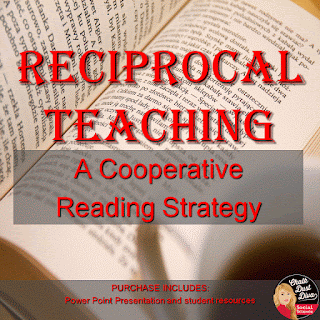
Reciprocal Cooperative Reading Strategy

One of my favorite reading strategies I use in my secondary history class is Reciprocal Teaching. So what is Reciprocal Teaching you may ask? It is a multi-strategy approach to assist students in understanding the meaning of text. Students are asked to:
  • make predictions about what is going on in the text
  • generate questions about the text content
  • seek clarification of points that are not well understood or confusing
  • summerize what has been read
 The goal of RT is to have the student automatically use these strategies when reading.

Here is a great resource to teach reciprocal teaching in the classroom. Comes with everything you need to easily implement this strategy in your classroom!

https://www.teacherspayteachers.com/Product/Reciprocal-Teaching-Strategy-Presentation-Student-Handouts-2700583

ab

Related Posts Plugin for WordPress, Blogger...